How Feathers came to be and helps preserve the details behind every sighting within my birding journey.
Last April, I woke up in Orange County, California on a cloudy mid-April morning to the sound of an unfamiliar bird song. I had arrived late the night before after spending the winter in Chicago. I’m sure many birders can relate to the excitement of being surrounded by a new avian ecosystem the first morning of a trip. I grabbed my binoculars, slipped into some shoes, and hurried out the door. Merlin soon helped me to discover that an Orange-crowned Warbler was responsible for the morning alarm. I tried to get a view for a few minutes and was unsuccessful due to dense foliage until the bird popped out at eye-level a few feet in front of me. We made eye contact for a few moments, and I could even make out the tiny but present orange crown on top of the head. A few minutes later I found a Spotted Towhee and a Bushtit. Upon returning to my room, I wanted to document my quick little morning adventure. My interest in birds had recently been invigorated after a long hiatus. Birding was a huge part of my life when I was 13-15 years old. My life list at the time was an excel sheet, and that’s what I pulled out to add to for the first time in nearly 12 years. Each row represented a species, and I had already added multiple columns to check off sightings by state and county, as well as my childhood yard and neighborhood.
I added a new row for the Orange-crowned Warbler and rediscovered that I had already seen a Bushtit and Spotted Towhee (in California) years ago. I found myself wanting to add some notes to capture the nuances of each of this morning’s sightings. Is there room for that in a matrix-like excel sheet? Even if I added a notes column, where could I add more notes the next time I had a memorable moment with a Bushtit? My OG life list format had just about reached its limit and felt like it was bursting at the seams with stories to tell.

The spreadsheet in question.
I figured eBird would be the next logical upgrade to my life list based on its popularity with modern birders. I opened the app and started to enter the morning’s sightings but quickly experienced a bit of data model dissonance. Did my short walk around the neighborhood really count as a “checklist”? What hotspot location would I choose in the middle of the resort-style grounds that I had strolled through? Beyond that, there was some extra data I was interested in that didn’t seem to have a home in eBird’s data entry ecosystem, but nonetheless felt like important dimensions to that morning’s story. Notably, I wanted to store location coordinates and timestamps for each sighting,resulting in a map of the session with each bird sighting marked, along with a timeline-style view that I could step back through and reminisce.
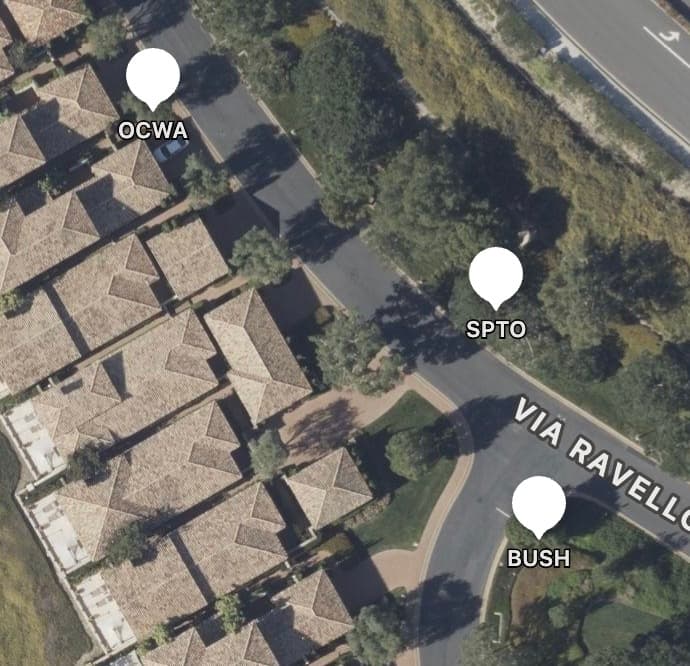
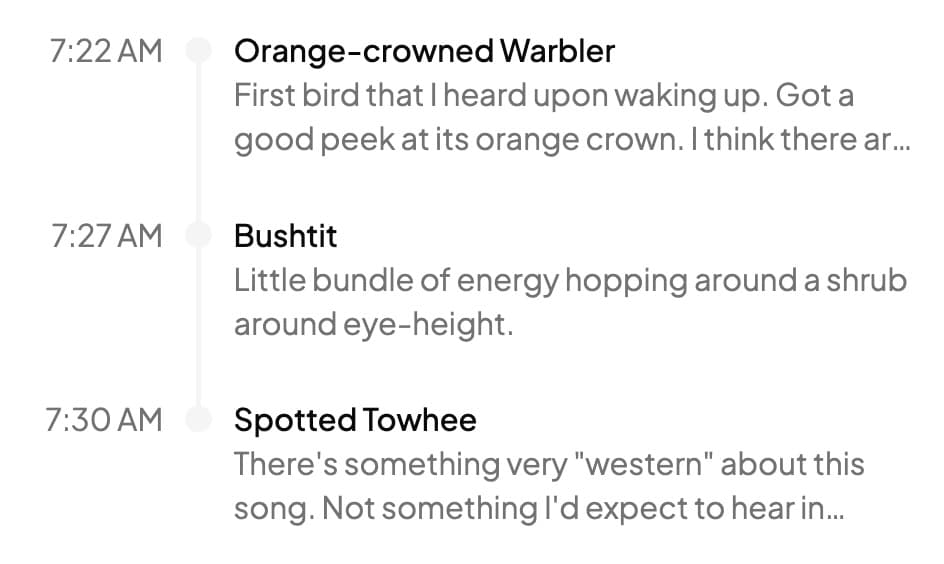
Session map and timeline views.
I built a new data model to satisfy my own desire for more structured data that centers on the individual sighting as the main entity, as opposed to a “checklist”. Sightings can be a part of a checklist or session (for example, that morning’s session consisted of three sightings), but they can also be one-off entries (like that group of Brown Pelicans flying overhead that I saw while driving a few hours later). Sightings are always stored with a pair of GPS coordinates, as well as a timestamp.
Thinking of sightings as the core entity for birding documentation unlocks a lot of cool ways to view and interact with the data. Yard and neighborhood lists simply become geofences, or an area marked with boundaries on a map, so that any sightings with coordinates in that area automatically become part of that list. Adding custom tags on each sighting allows tracking interesting trends and behavior - “these are all the species I’ve seen singing”, or, “these are the birds I’ve seen during a lake watch”. Rolling up to the species-level, precise coordinates for each sighting (and resulting maps) offer interesting breakdowns of your relationships with certain species over time.
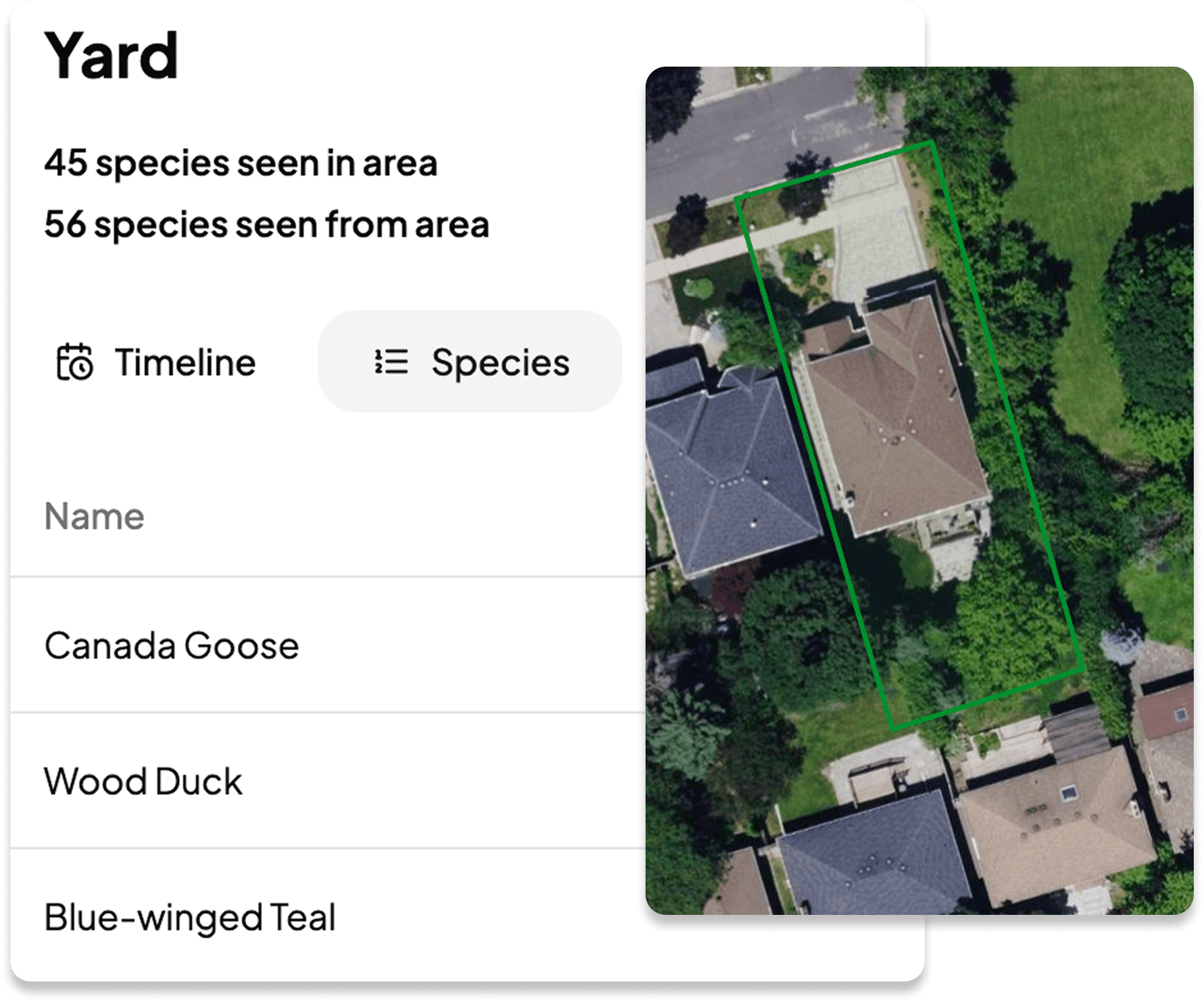
A geofenced yard.
The core data model expanded to include additional elements for sightings and sessions throughout the year, inspired by specific experiences. While watching a shrike in the same field over a few days in December, I became interested in tracking not only single coordinates, but also the path that the bird traveled as I familiarized myself with some of its consistent hunting circuits between perches. That level of detailed data entry for each and every sighting is overkill, but it’s nice to have the option for particularly memorable moments.
9 months later, this same ecosystem has grown into a massive collection of moments, stories, and memories. I built an iOS companion app for easy data entry in the field, and a web app that acts as a personal birding hub filled with maps, timelines, charts, and lots of other ways to slice and dice the data. I’m calling this product Feathers, and I really want to share it with folks who will be just as excited about it as I am.
What niche does Feathers fill in a world crowded with other birding apps? I think Feathers is the most powerful and flexible ecosystem for documenting your own personal journey, providing a home for all of the data and details that might be relevant to YOU as an individual. When I think of eBird’s purpose, I think of science, research, and large-scale data analysis. When I think of ABA Listing Central, I think of sharing checklists and friendly competition. Feathers is complementary to each of these platforms, but has different goals.
That said, I don’t want Feathers to replace either of those services. For example, everything entered in Feathers can and should be submitted to eBird (via a seamless export process that I follow for all of my own sessions). There will without a doubt be all sorts of bird-related applications and projects that surface over the coming years, each with different goals and value propositions. The beauty of collecting detailed, structured data now is that we don’t have to predict the future. We simply need to record today faithfully. Rich data creates long-term leverage, giving the freedom to adapt, integrate, and build alongside whatever emerges tomorrow.
If that framing resonates, the FAQ has a quick overview of how Feathers fits together across the web app and iOS app.
One last thought before I wrap up. I was watching a Rough-legged hawk at the top of a lone tree in the middle of a large open marsh last week. After about 10 minutes, it flew across the prairie to the north with its powerful, long-winged flight before flaring its striking black and white tail and landing high in another tree. Later that evening I opened Apple Maps’ 3D view and zoomed in on the same stretch of field. I was blown away by the level of 3D modeling detail already available today, so precise that the individual trees in my story appear as distinct objects, true to size amongst the surrounding environment. I had a quick daydream about being able to re-experience that birding session in some type of 3D virtual reality environment. Is that possible today? Not really. But if and when it becomes easy to pull something like that together with available technology, I want to be sure that my 2026 birding memories are ready to live on through new tools and experiences so I can share them with my children and my children’s children (who, hopefully, all think that birding is the coolest hobby). Feathers provides the data foundation behind these memories.
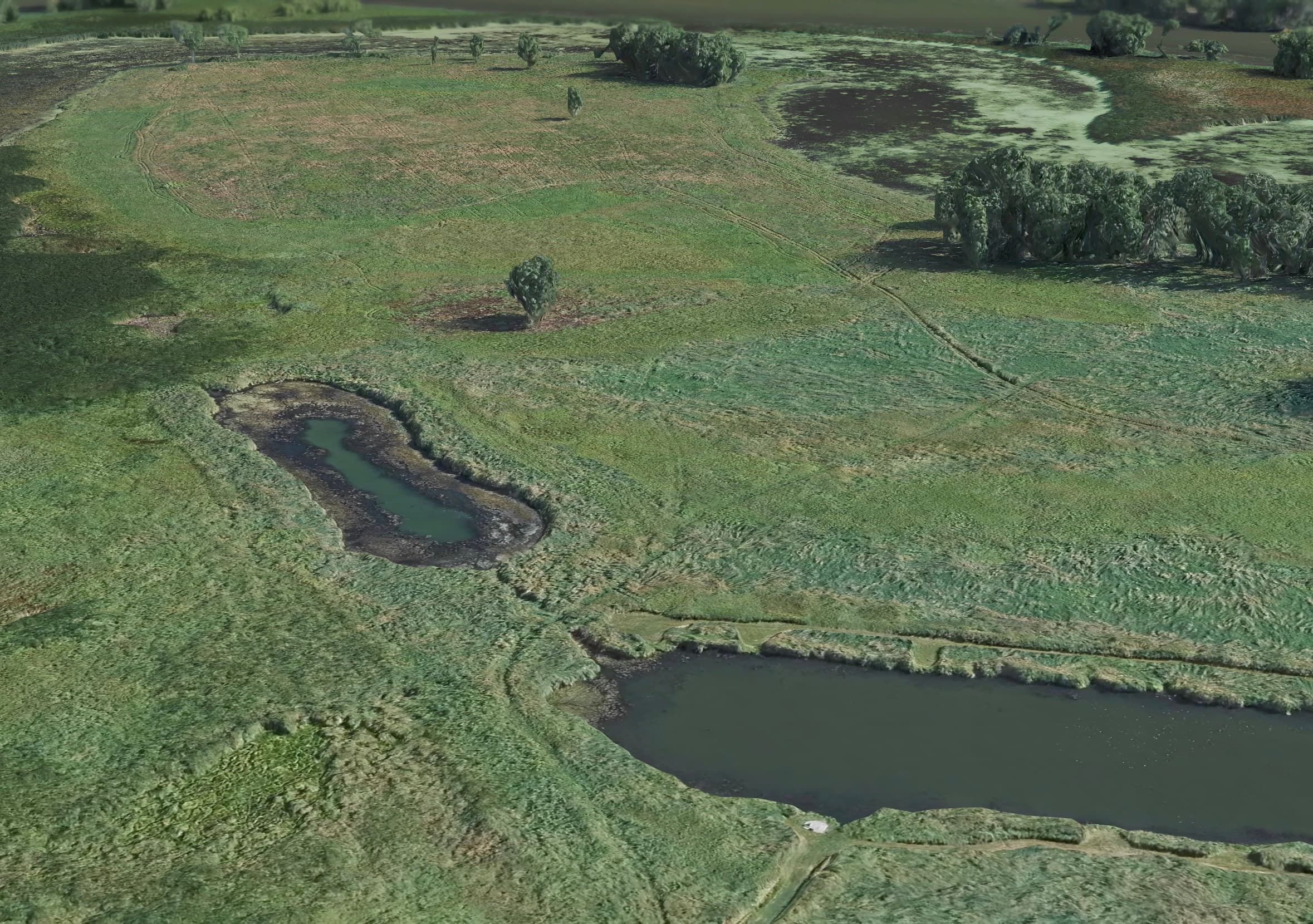
Apple Maps 3D view of the rough-legged territory.
I’m sure there are a lot of gaps in the current Feathers data model. If you’re reading this, I hope you’ll give Feathers a try, share feedback, and help evolve a data model to capture all of the nuances that make birding endlessly special.
Keep exploring
Jump to the FAQ for the quick overview.
